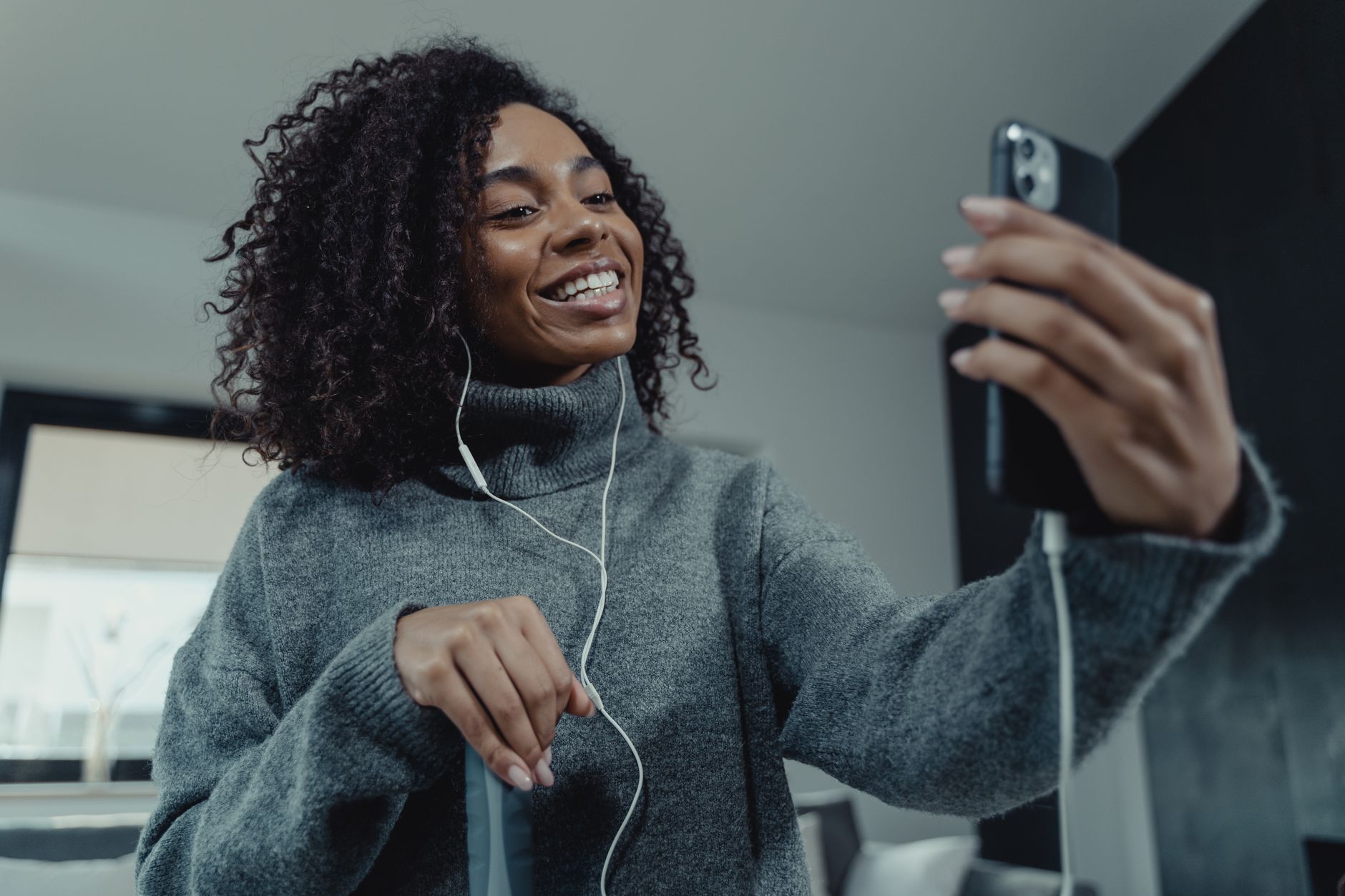
In short: You studied English for seven years at school, you read technical articles without difficulty, and yet the moment a real person appears on screen, your mind goes blank. Random video chat is one of the rare environments where you can practise a living language with native speakers, for free, without an appointment and with no lasting social stakes. But you mustn't treat it like a lottery. This guide offers a concrete method: how to prepare, what to say in the first twenty seconds, how to make the most of country filters, which languages are genuinely accessible through this channel — and why this exercise will never replace a structured course.
Why this format works (when it works)
The main obstacle to learning a language as an adult is almost never vocabulary or grammar. It's what language teaching specialists call the affective filter: the fear of saying it wrong, of looking ridiculous, of freezing up in front of someone. The linguist Stephen Krashen theorised this mechanism back in the 1980s, and it is widely taken up in European frameworks such as the CEFR (Common European Framework of Reference for Languages) from the Council of Europe, which ranks spoken interaction among the skills that take longest to acquire.
Random video chat attacks that filter fairly brutally and surprisingly effectively, for three reasons.
The stakes are zero. If you stumble over your words, your partner will vanish within ten seconds and you'll never see them again. No reputation to protect, no colleague who will remember your conjugation slip. That total absence of consequence is exactly what's missing from an evening class where you speak in front of twelve people you'll meet again the following week.
The repetition is massive. In a forty-minute session, you can string together fifteen to twenty-five conversation openings. So you'll repeat the same structures — introducing yourself, saying where you're from, asking what the other person does — until they become automatic. This is precisely the automation mechanism that spaced-repetition learning methods aim for.
The accent is authentic. You're not hearing the slow, carefully articulated English of a teaching recording, but the real English of a student from Manchester or a Texan who swallows half his syllables. Frustrating at first, formative afterwards.
Random video chat doesn't teach you a language. It teaches you to use the one you've already learned but never dared to put to work. The distinction is essential, and it determines the level at which the exercise starts paying off.
From what level should you start?
Let's be blunt: below a solid A2 level, the exercise is demoralising. If you can't understand a simple question asked at normal speed, you'll spend your session watching people wait and then leave, and you'll come away convinced you're "hopeless at languages".
| CEFR level | What video chat brings | Verdict |
|---|---|---|
| A1 | Very little: comprehension too weak to last 30 seconds | Avoid it, go for passive listening instead |
| A2 | Automating introduction formulas, getting used to accents | Useful, short sessions |
| B1 | The sweet spot: unlocking speech, rapid vocabulary growth | Highly worthwhile |
| B2 | Fluency, nuance, idiomatic expressions, humour | Highly worthwhile |
| C1+ | Maintaining your level, rare regional accents | Upkeep rather than learning |
If you're below A2, build a foundation first. An everyday conversation manual or a small pocket phrasebook is more than enough to install the fifty structures that come up in 80% of exchanges. You can then return to the platforms with enough to hold out for three minutes, which changes everything.

Preparing a session: fifteen minutes that change everything
The beginner's mistake is to log on with nothing prepared, hoping it "will just come". It doesn't. Here's the protocol that turns a sterile session into a proper training drill.
1. Set a single objective
One session = one objective. Not three. For example:
- "Today I'm working solely on the question What do you do for a living? and its variants."
- "Today I'll use the expression I'd rather… five times."
- "Today I'll tell ten different people about my weekend, improving each time."
That last exercise — repeating the same anecdote a dozen times in a row — is formidably effective. The tenth version is always better than the first: more fluent, better structured, and the words you were missing at the start have been looked up in the meantime.
2. Prepare a visible cheat sheet
Write out on a sheet of paper, propped next to the screen or taped under the webcam, a dozen fallback sentences:
- Sorry, could you say that again more slowly?
- How do you say … in English?
- I'm learning English, thanks for your patience.
- What does that mean?
That third line deserves to be announced right from the start. Saying up front that you're practising the language radically changes your partner's behaviour: most people slow down, rephrase and become noticeably more supportive. A spiral vocabulary notebook kept within reach lets you jot down, in the heat of the moment, the word you didn't have — that's when memorisation is strongest, not two hours later.
3. Take care of the audio before the picture
This is the most underrated point. In a foreign language, your comprehension depends entirely on the quality of the sound signal: a crackling microphone or room echo turns perfectly clear English into incomprehensible mush. A noise-cancelling USB headset will change your learning experience more than any app. It eliminates echo, isolates your partner's voice and spares you having to ask three times.
Test your own sound too: if your interlocutor has to guess what you're saying, they'll cut it short. Speak about thirty centimetres from the mic, in a room with soft furnishings (curtains, sofa, rug) rather than in a bare office where reverberation muddies everything.
The first twenty seconds: the real bottleneck
On a random platform, everything is decided immediately. Stay silent for two seconds and the other person moves on. Here's what works.
Speak first. Every single time. An energetic "Hi! How's it going?" launched within the first second dramatically lowers the instant-disconnect rate.
Announce your project early. "Hey, I'm French, I'm practising my English — do you have five minutes?" This sentence filters naturally: those who were looking for something else leave, and those who stay are available for a real conversation.
Have a non-generic opening question. "Where are you from?" is fine but worn out. Openers like "What's the weather like where you are right now?" or "What's something typical from your city that tourists never see?" produce long answers, and therefore useful listening.
Accept the sorting process. Out of twenty connections, you might get three conversations lasting more than five minutes. That's normal, that's the format. Don't read it as personal rejection: most people click on reflex, not on judgement.
Making the most of geographic filters
This is the most useful and least used tool. Most major random video chat platforms offer a filter by country or region, sometimes reserved for premium accounts. For a learner, this filter is what turns randomness into targeting.
A few practical pointers depending on the language you're after:
- English: it's the default language of the vast majority of exchanges, including between non-native speakers. Paradoxically, you'll mostly practise international English (Indian, Turkish, Brazilian, European) — excellent for fluency, less so for a native accent. For native speakers, explicitly target the United States, the United Kingdom or Canada, and favour time slots matching their local evening.
- Spanish: very accessible, with a strong Latin American presence. Watch out for significant vocabulary differences between Spain, Mexico and Argentina.
- Italian and Portuguese: a real but more scattered presence, with peaks in the European evening for Italian and heavy Brazilian activity for Portuguese.
- German, Dutch, Scandinavian languages: many people spontaneously switch to English as soon as they spot a foreigner. You have to insist explicitly to stay in the target language.
- Arabic, Turkish, Russian: a significant presence on certain platforms, but with a very high proportion of men and expectations sometimes far removed from language exchange.
The time factor matters at least as much as the country filter. Logging on at 3 p.m. on a Tuesday to talk to Americans is like looking for crowds in a sleeping town: aim instead for 9 p.m. to midnight local time in your target country, which sometimes means late sessions for American time zones.
What the exercise will never do for you
You have to be honest about the limits, or you'll lose months.
No reliable correction. Your partner won't correct you, or will do it badly. They'll understand what you mean and move on. So you can go on fossilising mistakes for years in complete confidence. That's the format's major flaw, and it has only one remedy: keeping a normative source alongside — an English grammar workbook or a teacher — to check what you're producing.
No progress in reading or writing. The exercise works on spoken interaction, full stop. The CEFR clearly distinguishes five skills; you're training one and a half of them.
A capped vocabulary. Three-minute conversations revolve around the same twenty topics: origin, weather, music, films, work, travel. You'll hit a plateau very quickly if you don't deliberately force new lexical fields to appear (cooking, local politics, sport, technology).
A non-educational environment. Random video chat platforms are not designed for learning. They contain unsuitable content, inappropriate behaviour and uneven moderation. The same caution rules as for any other use apply: no full name, no social media handles, no identifiable background, and disconnect immediately if you feel uncomfortable. The CNIL regularly points out that data broadcast over video — voice, face, surroundings — constitutes personal data in its own right.
A realistic weekly protocol
Here's a sustainable rhythm, tested and compatible with a busy life.
| Day | Activity | Duration |
|---|---|---|
| Monday | Video chat session, objective "introducing yourself" | 25 min |
| Tuesday | Reviewing Monday's vocabulary notebook | 10 min |
| Wednesday | Video chat session, objective "telling an anecdote" | 30 min |
| Thursday | Passive listening (podcast, series in the original language) | 20 min |
| Friday | Free video chat session, no objective | 30 min |
| Weekend | Grammar or reading | 30 min |
Three conversation sessions a week are enough to see a clear breakthrough within six to eight weeks. The marker of progress isn't "I make fewer mistakes" but "I think less before speaking".
The little ritual that makes the difference
Record yourself, or at the very least write down immediately after each session the three words you were missing. After a month, this list becomes your personalised syllabus: these are exactly the words you need, not those of a generic textbook. A desk timer set to 25 minutes also prevents the classic drift where a twenty-minute training session turns into two hours of unproductive channel-hopping.
In summary
Random video chat is a conversation simulator, not a course. Used without a method, it produces twenty "hellos" an hour and zero progress. Used with a clear objective, a cheat sheet, good audio and a notebook, it solves the problem that neither apps nor textbooks know how to tackle: the fear of speaking. Combine it with a serious grammar resource, keep the usual safety reflexes, and you have the cheapest speaking practice in existence — provided you accept that seventeen people out of twenty will hang up on you without it meaning anything whatsoever about you.