In brief: you have got into the habit of protecting your exchanges at home — neutral background, no first name, never your whole face. Then you travel. A holiday, a work assignment, a cousin's wedding, a trip back to your parents' country. In some sixty States, same-sex relations are still punishable under criminal law, and in several of them the phone has become the most convenient piece of evidence: a dating app installed, a video chat history, a screenshot, a conversation. This article sets out what a device check can actually reveal, how to prepare a travel phone without losing your digital life, what the law says about border searches in Europe, and what to do if your device is seized or unlocked under pressure.
This article describes legislation, NGO reports and digital security practices. It does not constitute personalised legal advice and guarantees no particular outcome when facing a foreign authority. Before any departure, consult the travel advice issued by the French Ministry for Europe and Foreign Affairs (France Diplomatie) for the country concerned. If you run into difficulty abroad: the consulate or embassy of your country of nationality, and the Quai d'Orsay's Crisis and Support Centre. Sexual orientation and discrimination: SOS homophobie helpline, 01 48 06 42 41. In Belgium: Lumi, 0800 99 533.
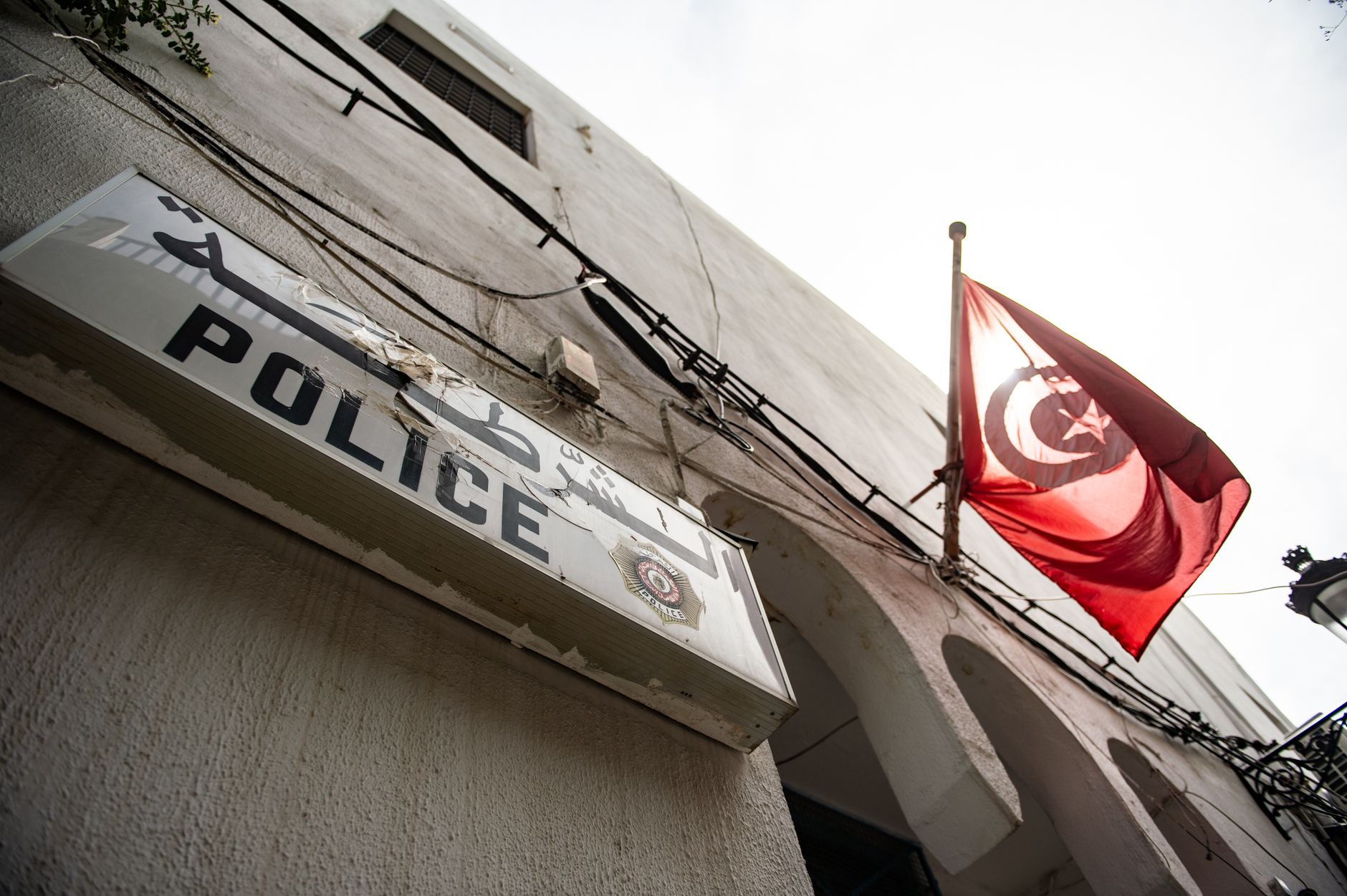
The phone, the evidence of first resort
Human Rights Watch reports on the Middle East and North Africa, and Amnesty International reports on sub-Saharan Africa, have converged for several years on the same finding: prosecutions for "debauchery", "unnatural acts" or "indecency" rest more and more on digital material. In its 2023 report on online entrapment in the region, Human Rights Watch documented arrests triggered by a photo, a conversation on an app, or the mere fact that a dating app appeared among the icons on the home screen. In February 2025, Amnesty International described a wave of arrests in Tunisia in which phones play a central role, and in 2024 it documented the shrinking of LGBTQ+ digital space in Uganda after the law was tightened.
What this changes for a reader who uses video chat: precautions designed for the screen — neutral background, assumed first name, framing — protect nothing at all once the device itself is in someone else's hands. The risk shifts from the webcam to the phone's memory.
| What gets checked | What it can reveal |
|---|---|
| Home screen and app list | Dating apps, VPNs, encrypted messaging |
| Browser | History, open tabs, saved video chat sites, stored passwords |
| Photo gallery and cloud albums | Screenshots of conversations, party photos, selfies |
| Messaging apps | Conversations, attachments, community groups |
| Notifications | Message previews even with the device locked |
| App stores | Download history, even after uninstalling |
That last point is the one most often forgotten: deleting an app does not delete the record of its purchase or download from the account history. On an unlocked device, that history is three taps away.
Before you leave: the honest trade-off
The first question is not technical, it is factual: what is the state of the law in the country you are going to, and what happens in practice?
Three public sources will give you a serious picture:
- France Diplomatie's travel advice, which explicitly flags, for the countries concerned, the criminalisation of homosexual relations and recommends discretion.
- ILGA World's annual report on State-sponsored homophobia, which lists the laws in force country by country and how they have changed.
- Human Rights Watch and Amnesty International reports, which describe practice — arrests, entrapment methods, use of phones — where the text of the law alone says nothing about enforcement.
Between "dormant law never applied" and "arrest campaign under way", the gap is enormous, and it shifts. Ghana tightened its legislative framework in 2024; Uganda did so in 2023. Last year's information is not enough.
The three travel profiles
How much preparation you need depends a great deal on your situation.
The foreign tourist passing through. The risk of a device check on entry is low in most destinations, but exposure on the ground is real in the event of an identity check, a raid on a venue, or a date that goes wrong. It is often on the ground, not at the border, that the phone gets looked at.
The dual national or the family visitor. The trickiest situation: you do not always benefit from the consular protection of the country whose other passport you hold, and the risk of being outed to your family is layered on top of the legal risk. We covered the legal context in the Maghreb in our article on criminalisation and online entrapment in Algeria, Tunisia and Morocco.
The business trip. The phone is often a company device, with remote management tools and sometimes logging on the employer's side. Mixing your gay life online with a work handset is a bad idea in any case, and a very bad idea in this context.
Preparing a travel device, in practical terms
The aim is not to travel with an "empty" phone — an abnormally clean device draws as much attention as a talkative one. The aim is a device that is credible and poor in sensitive information.
Option 1: the second phone
This is the most robust solution and the easiest to explain. An entry-level smartphone, bought new or refurbished, with a dedicated account, your useful contacts, a family messaging app, your tickets, your cards. Nothing else. Plenty of travellers already carry a second phone for a local SIM card: there is nothing unusual about it.
Plan for keeping it running: a high-capacity power bank saves you from having to hand the device over to a stranger to charge it, and a universal plug adapter spares you borrowing a charger locally.
Option 2: cleaning up your main device
If you are travelling with your usual phone only, work through this in order, at least a week before departure — a device reset the day before stands out immediately from its file dates.
- Back everything up onto storage that stays at home. An external SSD drive or a good encrypted USB stick will do; what matters is that it does not travel with you.
- Uninstall dating apps and also remove them from your account history where the platform allows it (hiding purchases on iOS, removing them from your library on Android).
- Clean out the browser: history, pinned tabs, bookmarks, saved passwords, autofill suggestions. Video chat sites tend to resurface through autocomplete, not through history.
- Sort through the gallery, including the bin, hidden albums and screenshots. Many devices keep thirty days of deletions.
- Log out of secondary accounts and leave community groups on your messaging apps. A list of groups says as much as a conversation.
- Turn off notification previews on the lock screen. This is the most common leak, and the only one that requires no unlocking at all.
- Replace biometric unlocking with a long passcode for the duration of the trip: in several jurisdictions, a fingerprint or a face is legally easier to obtain than a code.
Our detailed recommendations on day-to-day discretion are set out in the discretion guide for people who are not out yet, which remains the baseline to apply before you even start thinking about travel.

What the law says about phone searches
In Europe, the situation is regulated, even if it is not as protective as people imagine.
- In France, the Constitutional Council struck down in 2022 (decision no. 2022-1030 QPC) the arrangement that allowed customs officers to inspect data on a device without sufficient oversight; the framework has since been tightened by the legislature. In principle, the inspection of a phone by law enforcement presupposes an identified procedural framework.
- At European level, the Court of Justice of the European Union held in 2023 (case C-548/21) that access to the data on a phone constitutes a serious interference with private life, which must be proportionate and subject to review.
- The European Court of Human Rights, for its part, has built up solid case law on the protection of data relating to sexual orientation, a particularly sensitive category under Article 8 of the Convention.
These safeguards stop at the external border. In a country that criminalises homosexuality there is often no effective remedy, and the General Data Protection Regulation does not follow you. The useful instinct is therefore preventive, not litigious: what is not on the device cannot be read.
What about a VPN?
A VPN protects the content of your traffic from being observed by the network, not from the device being inspected. In some contexts its very presence may even be read as a sign of concealment — and its use is restricted or illegal in several countries. We set out what a VPN really protects and what it does not in our article on what your IP address reveals in video chat.
On the ground: is video chat still worth it?
A fair question, and the honest answer is: it depends on what you are looking for.
In this context, random video chat has a structural advantage over geolocated dating apps: it requires no account, no profile and no persistent photo, and it does not display your distance from other users. A platform you access from the browser leaves no icon on the home screen. That asymmetry of exposure is exactly what we compared in gay dating apps or video chat: what each one really exposes about you.
But video chat brings its own risk, and it is a serious one: you appear on video, live, and the person on the other end can record. In a country where a single screenshot is enough to open proceedings, the calculation changes. A few minimum rules if you use video chat while away:
- Never your whole face, and nothing recognisable about the hotel or accommodation in the background. A bare wall, or a small foldable green screen if you are travelling with a laptop.
- Never arrange a face-to-face meeting from abroad in these countries: this is the entrapment scenario documented by Human Rights Watch, and the most dangerous one.
- Avoid hotel Wi-Fi for this kind of use if you can; mobile data from a local SIM card is often preferable. An eSIM adapter or dual-SIM reader makes switching easier.
- A stick-on webcam cover on the laptop, as basic hygiene, and close the browser completely after use.
- A private browsing window, then a manual check of autocomplete.
The basic moves — report, block, keep evidence without circulating it — are the same as at home, and are detailed in our guide on what to do after a bad exchange.
If your phone is seized or unlocked under pressure
The worst-case scenario, and the one to have thought through calmly in advance.
| Situation | Useful instinct |
|---|---|
| You are asked for your passcode | Do not lie about verifiable facts; never physically resist |
| Device taken out of your sight | Treat every account as compromised, including after it is returned |
| Device returned | Do not log back in with your main accounts; treat it as suspect |
| Pressure, threats, demands for money | Contact the consulate as soon as possible; note the time, place, service and names |
From a safe device — one belonging to someone you trust back home, or a computer you trust — immediately change the passwords for your main email account, then your social networks, and revoke active sessions. A password manager on paper or in encrypted form, prepared before departure, makes this a twenty-minute job instead of a two-day one.
If the threat takes the form of blackmail over being outed, the logic of documenting it and filing a complaint once you are home is the one described in our article on homophobic ambushes and blackmail arising from a video chat.
And when you get back
Three steps that often get overlooked:
- Do not blindly restore your backup onto a device that has left your sight. Reset it first.
- Check active logins on your accounts, the auto-forwarding rules on your email, and authorised devices.
- Assess what was seen, without paranoia but without playing it down, so you know which people around you might be affected.
If, in your case, the journey was not a choice but an escape, and you are considering applying for protection, our material on the value — and the cost — of digital traces can be found in the article on applying for asylum on grounds of LGBT+ persecution.
Key takeaways
Protection while travelling is not decided at the border, it is decided three weeks earlier, when you choose what your phone will carry. A device poor in information, a long passcode instead of a fingerprint, silent notifications, and no icon that speaks on your behalf: it is that combination, not some miracle tool, that makes the difference. The rest is a matter of caution on the ground and clear-sightedness about what local law can, or cannot, offer you. Our general security recommendations are gathered on our safety tips page.