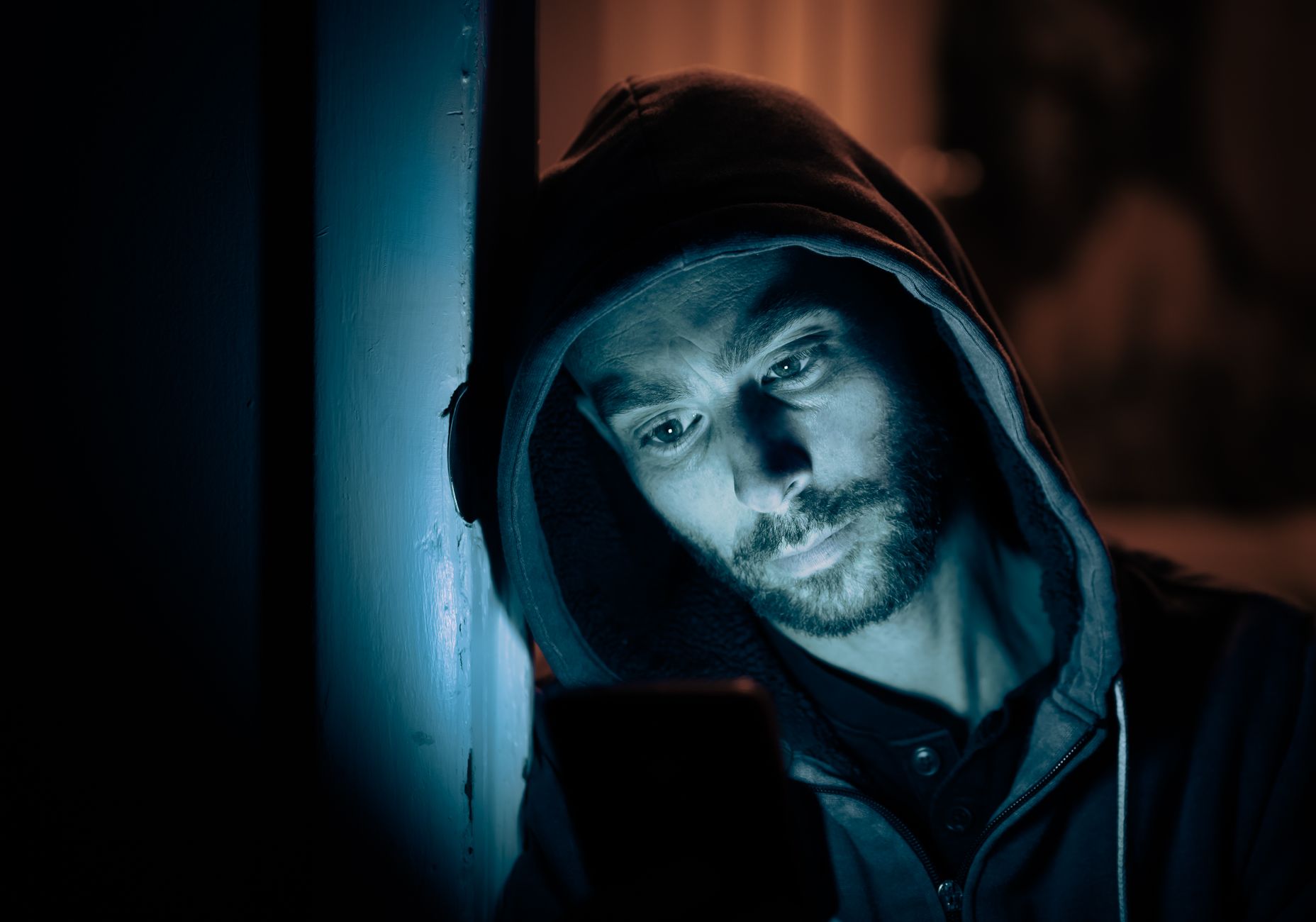
In short: for a gay or bisexual man who depends on a family carer, a home care worker or a care home's staff, discretion on video chat isn't decided in your browser settings. It's decided by a door that opens without a knock, a screen read over your shoulder during a transfer, a phone handled by someone else, a call list looked through "by chance". The law, for its part, is clear: the privacy and intimacy of people receiving care are protected, and sexual orientation is sensitive data under the GDPR. This guide sets out the leak points specific to dependency, the practical habits that hold up in real life, and the remedies available in France and Belgium when privacy isn't respected.
This article describes personal safety practices, support organisations and the general legal framework. It does not constitute personalised legal advice. In France: SOS homophobie helpline 01 48 06 42 41; Défenseur des droits (Defender of Rights) 09 69 39 00 00; the Interior Ministry's PHAROS platform for illegal content; 3977 for abuse of vulnerable adults; emergency services 17 or 112, text message to 114 for people who are deaf or unable to speak. In Belgium: Unia 0800 12 800; Lumi 0800 99 533; Écoute Violences (Violence Helpline) 0800 30 030.

A very common situation, almost never documented
There's plenty of talk about discretion for gay men who still live with their parents, or who worry about a colleague. Far less about a scenario that is nonetheless widespread: adults who, for reasons of health, physical disability, progressive chronic illness or age, never have a genuinely closed space. According to the DREES, several million people in France receive regular help at home or live in a care facility; the CNSA, for its part, points out that human assistance often covers the most intimate moments of the day — washing, dressing, transfers, eating, help with screens.
Layer on top of that what the FRA's (European Union Agency for Fundamental Rights) LGBTI Survey documents: a significant share of respondents conceal their sexual orientation in care settings, for fear of being treated differently. In France, organisations such as GreyPRIDE or Les Audacieuses et les Audacieux work precisely on the invisibility of older or dependent LGBT+ people in care settings. The result is a blind spot: men who, after sometimes living freely for thirty years, go "back into the closet" at the very moment they need help.
Man-to-man video chat then becomes, for many, the only workable space. No journey, no stairs, no inaccessible bar, no accessible transport to book forty-eight hours in advance. That's a real gain — and it's also, inevitably, the point where intimacy becomes most visible.
The leak points specific to dependency
They aren't the same as for an independent user. Listing them plainly makes it possible to deal with them one by one.
| Leak point | What actually happens | What reduces it |
|---|---|---|
| The door | Someone comes in without knocking, during a round or an unscheduled visit | Agreed time slot, visible sign on the door, screen position |
| The screen | Read over your shoulder during a transfer or while you're being settled | Screen angle, privacy filter, short session |
| The sound | A contact's voice heard from the corridor | Earphones, low volume, chosen time slot |
| The device | Phone or tablet handled by someone else to help you | Lock screen, separate profile, hidden notifications |
| The traces | History, photo gallery, app notifications, shared backup | Routine clean-up, dedicated account, no screenshots kept |
| The network | The facility's or the family's Wi-Fi, logging possible | Your own mobile connection where feasible |
Two of these rows deserve more detail, because they have no equivalent for an independent user.
The device handled by someone else. When another person unlocks your phone to hand it to you, opens a browser, plugs in a cable or wipes a keyboard, they inevitably see what's on it. This isn't malice: it's the everyday reality of human assistance. So the answer isn't suspicion, it's architecture: whatever must stay private shouldn't be in the path of the helping gesture.
The shared network. In a care facility, the Wi-Fi is often administered by the organisation. Nothing entitles a staff member to look at your activity to satisfy their curiosity, but managed infrastructure is still managed infrastructure. We've set out what a connection really reveals in VPNs and random video chat: what your IP address really gives away.
Organise time before organising technology
In this configuration, the most effective protection isn't software: it's a time slot.
- Identify the genuinely free windows. Between two visits from the care worker, while the family carer is out, after the evening round in a care home. Write them down. A known forty-minute window is worth more than three uncertain hours.
- Negotiate the unexpected. Saying "I'd rather people knocked and waited for me to answer" is a legitimate request, and it doesn't have to be justified. You can have it written into your personalised care plan in a facility, or into the communication log at home.
- Use a neutral signal. A "busy, please wait" sign hung on the handle settles a lot of situations without revealing anything. A simple occupied/free door sign, bought for a few euros, is enough and passes for a work or rest habit.
- Plan your exit from the session. A keyboard shortcut you know, a key that cuts the camera, a gesture repeated often enough to become reflex. The goal: being able to leave a conversation in two seconds without searching.
If your motor abilities make these movements slow, a wireless presentation remote or a programmable button placed within reach can replace fine manipulation: one press, and the window closes.
Making the screen and the sound less conspicuous
Once your time is organised, three hardware adjustments do most of the work.
The angle. The screen should never face the door. In a room where the bed is fixed and there's a single door, that's sometimes impossible — hence the value of an adjustable screen stand for bed use or an articulated arm that lets you swivel the display forty-five degrees in a second.
The filter. A screen privacy filter blacks out the image as soon as it's viewed from an angle. It's the most underrated accessory in a setting where people walk past you all day long. It fits a laptop just as well as a tablet.
The sound. Earphones, always, at a moderate volume: leaking sound is the number one trigger of curiosity. In a shared room or an echoing corridor, bone conduction headphones leave your ears free — useful for hearing someone coming while keeping the conversation private. We've covered the audio side in Sound, the secret weapon of random video chat.

What your room says about you
A medicalised or adapted room is highly identifying: a height-adjustable bed, a patient hoist, a particular wheelchair model, a facility label on a piece of furniture, a schedule board on the wall with a name and a floor number. On camera, all of that adds up to a business card.
Two practical consequences. First, frame tightly: upper body, neutral background, no pan around the room. A matte folding panel placed behind you, or simply a bare wall, solves the problem better than a virtual background that falls apart as soon as you move. Second, get text out of frame: schedules, prescriptions, letters, labels. A medical document caught on camera in the background is health data being broadcast. The full reasoning is developed in What your background says about you on random video chat.
One often overlooked detail: light. In a room lit by a ceiling fixture, your face looks flat and the screen becomes the only light source visible from the corridor at night. A small adjustable LED lamp aimed at you improves the picture and reduces the blue glow that signals, from a distance, that a camera is running.
Your rights, precisely
In France
The Code de l'action sociale et des familles (Social Action and Families Code) guarantees people receiving care, in article L. 311-3, respect for their dignity, integrity, privacy and intimacy, as well as free choice between care at home and in a facility. The charte des droits et libertés de la personne accueillie (charter of rights and freedoms of the person受 in care), appended to the same code, is displayed in facilities: it explicitly enshrines the right to intimacy and confidentiality.
On the data side, sexual orientation is sensitive data under article 9 of the GDPR: collecting it, recording it in a file or passing it on without a legal basis is unlawful, and the CNIL can be petitioned. On the criminal side, three offences are worth knowing:
- breach of professional confidentiality (article 226-13 of the Criminal Code), which applies to health and social care professionals;
- invasion of privacy, in particular capturing or sharing images of a person in a private place without their consent (articles 226-1 and 226-2);
- blackmail (article 312-10), and threats of disclosure, with aggravating circumstances when they target sexual orientation.
Discrimination based on sexual orientation is prohibited, including in access to a service or to care: the Défenseur des droits (Defender of Rights) has jurisdiction, and its reports on the rights of older and disabled people regularly document breaches of privacy in care settings. For any situation of abuse or neglect of a vulnerable adult, 3977 is the national helpline number.
In Belgium
Unia handles discrimination based on sexual orientation, including in care and support services. The Walloon decree on residential facilities for older people, along with Flemish and Brussels regulations, require residents' privacy to be respected. Lumi (0800 99 533) is the national LGBT+ helpline, and the Autorité de protection des données (Data Protection Authority) is the equivalent of the CNIL for sensitive data.
When the caregiver is the problem
This is the hardest configuration, and it does happen: a hostile family carer, a care worker who makes comments, staff who "joke" in front of other residents, a relative who threatens to tell the whole family. Dependency creates a power imbalance — you can't slam the door on someone you need in order to get out of bed.
A few principles that hold up in this context:
- Write it down, date it, keep it. Note every incident with the date, time, name and exact wording in a paper notebook or a file kept off the device others handle. A hardback notebook stored in a lockable drawer is sometimes still the safest medium when your digital device is handled by others.
- Go through an institutional third party before any confrontation. Your GP, the service's social worker, your designated person of trust, the residents' committee in a facility, the care service itself: an organisation has an obligation to act on a report.
- Appoint a person of trust. The mechanism exists in French law and lets your requests be carried by someone who isn't in a position of dependency towards the team.
- Never negotiate with blackmail. A payment doesn't stop a threat, it confirms it. The steps to follow are set out in Homophobic set-ups and blackmail arising from video chat: spotting it, documenting it, reporting it.
And if the damage is done, if your orientation has circulated around the facility or the family without your consent, there is a course of action to limit the spread and regain control: Outed against your will after a video chat.
What video chat genuinely brings here
This needs saying too, because this kind of article quickly turns into a catalogue of risks. For a man whose mobility is reduced, whose fatigue limits going out, whose circle of friends has thinned out with each hospital stay, a cam-to-cam conversation does three things no written forum does: it restores a voice, a face and a conversational rhythm. It's a complete form of sociability, not a second-best.
Three markers to keep it beneficial:
- Favour depth over quantity. Two real conversations a week are worth more than an hour of scrolling.
- Don't let the screen replace everything else. Local organisations, accessible LGBT+ drop-in services and helplines exist and require no travel at all.
- Set your limits before you connect, not during. No screenshots, no surname, no facility name, no face if the context doesn't allow it.
Our neighbouring guides usefully round out this framework: Random video chat and accessibility for the hardware and ergonomics side, Gay, alone and not so young any more: video chat when the community has drifted away for the isolation side, and the /safety page for a summary of the site's safety reflexes.
Key takeaways
- Dependency shifts the problem of discretion: it becomes spatial and organisational before it is technical.
- Agreeing on a time slot, a door sign and a knock-before-entering rule protects you more than any setting.
- Three accessories make the difference: a privacy filter, earphones, an adjustable screen stand.
- Frame tightly, and move every document and label out of the camera's view.
- In France, article L. 311-3 of the Code de l'action sociale et des familles and the GDPR protect your privacy and your sexual orientation; 3977 and the Défenseur des droits can be contacted. In Belgium: Unia and Lumi.
- Faced with blackmail or a homophobic comment from a caregiver: document it, go through an institutional third party, never pay.