In short: for an adult gay, bisexual or questioning man serving in the armed forces, the national police, the gendarmerie, the fire service or the prison administration, discretion on video chat isn't decided in a browser's settings. It is decided in a shared barrack room, in housing located inside a military compound, with a personal phone left in a communal locker room, on a computer issued by the employer, and within a corps culture where private life travels fast. The law, for its part, is clear: sexual orientation is sensitive data under the GDPR, discrimination based on sexual orientation is prohibited in the public service, and the "duty of discretion" does not cover your private life. This guide details the leak points specific to these jobs, the concrete habits that hold up in real life, and the remedies available in France and Belgium.
This article describes personal security practices, institutional mechanisms and the general legal framework. It does not constitute personalised legal advice. In France: SOS homophobie helpline 01 48 06 42 41; Défenseur des droits (Defender of Rights) 09 69 39 00 00; the Ministry of the Interior's PHAROS platform for illegal content; the Ministry of the Armed Forces' Thémis unit for discrimination and harassment; emergencies 17 or 112, text message to 114. In Belgium: Unia 0800 12 800; Lumi 0800 99 533. Everyone mentioned here is an adult.

A job that almost never leaves a door you can close
There is plenty of advice on discretion out there, written for someone who has a studio flat, an internet box in their own name and a phone nobody else ever touches. That is not the situation of an enlisted soldier housed in a barrack room, a trainee police officer at the academy, a gendarme housed in barracks out of absolute service necessity, or a professional firefighter sleeping through a twenty-four-hour shift in a communal dormitory.
These jobs share five features that change everything:
- Housing tied to the employer. In the gendarmerie, housing granted out of absolute service necessity places your home inside the service compound itself: neighbours, colleagues and chain of command all blend into one.
- Genuinely communal spaces. Barrack room, duty dormitory, locker room, common room: there is often nowhere you can reliably be alone, and the door you close doesn't always have a lock.
- Equipment that isn't yours. Workstations, service tablets, work phones, internal Wi-Fi: everything is administered, logged, and governed by an IT usage policy.
- A tightly knit group culture. Corps loyalty is hugely protective — and it also circulates personal information at frightening speed.
- Travel and deployments. Overseas operations, training courses, secondments, sometimes to countries where homosexuality is criminalised.
None of this is a reason to give up on a love life or on cam-to-cam conversations. It is a reason to have a protocol, and to stick to it.
What the law says, and what it doesn't
First point to state plainly, because a lot of misconceptions circulate in barrack rooms: your sexual orientation is not a work matter.
- Article 225-1 of the French Criminal Code lists sexual orientation among the prohibited grounds of discrimination. In the public service, the code général de la fonction publique (General Civil Service Code) prohibits any distinction based on that ground in recruitment, promotion, posting or performance appraisal.
- The GDPR (Article 9) classifies data revealing sexual life or sexual orientation as sensitive data, the processing of which is prohibited in principle. The CNIL (French data protection authority) regularly points out that an employer may neither collect, store nor disclose such information.
- The duty of discretion and the obligation of professional confidentiality concern the public expression of opinions linked to your role, and service-related information. They create no obligation whatsoever to keep quiet about your private life, let alone to justify it.
- The general statute of military personnel (Defence Code) regulates public expression, but for several years the Ministry of the Armed Forces has had an explicit anti-discrimination policy, including the Thémis unit, a dedicated reporting point for harassment, discrimination and violence.
In other words: if a superior or colleagues find out that an adult soldier or police officer has video chats with other men, that is a private matter. If it leads to mockery, exclusion, a change of posting or a downgraded appraisal, you have left the private sphere and entered harassment and discrimination, which can be proven and challenged. Our article on the professional consequences of a gay online life being discovered details the levers common to all employers.
The leak points specific to barracks
Service equipment: a zone to avoid entirely
This is the simplest and the least negotiable point: nothing personal on work equipment. No video chat, no account, no browser session, no "just two minutes" on a shared workstation.
The reasons aren't moral, they are technical and legal. State information systems are administered, logged, and sometimes subject to security audits. The IT usage policy you signed allows checks. A browsing history, a cookie, a password saved in a shared browser, a notification popping up during a meeting: any one of those details is enough to turn a private life into a case file.
Corollary: the internal Wi-Fi is not your network. Even for tolerated personal use, go through your mobile data plan. In a concrete building where 4G barely reaches, a small repeater or a personal 4G router for your room solves the problem without touching the administered network — and keeps you in control of your connection.
The barrack room, the dormitory, the night shift
Sound is the first traitor. A man's voice in headphones is silent to everyone else; a voice coming out of a phone speaker goes straight through a barrack-room partition. So work on two things:
- Containing outgoing sound: a closed-back noise-cancelling headset with a microphone, used systematically, is the only truly indispensable piece of equipment on this list. Closed over-ear models leak far less than open earbuds.
- Containing incoming sound: speak quietly, or don't turn the microphone on at all. Plenty of cam-to-cam conversations work perfectly well by keyboard, especially somewhere you can't talk.
The second traitor is the screen. In a dormitory, a common room, a vehicle, a train on the way to a mission: someone is always walking behind you. A privacy screen filter narrows the viewing angle to a tight cone and costs about ten euros. Pair it with the habit of always keeping a neutral tab in the foreground and of closing the laptop lid — not minimising the window — when someone walks in.
The phone, the most exposed object in the barracks
A personal phone left in a locker room, a bag put down in an armoury, a charger in a shared office: the device is physically accessible far more often than people assume.
| Risk | Concrete habit |
|---|---|
| Someone picks up the unlocked device | Auto-lock at 30 seconds, biometrics enabled |
| Notifications read over your shoulder | Content previews hidden on the lock screen |
| A colleague "looks at a photo" and swipes through the gallery | Locked album, and nothing sensitive in the camera roll |
| Loss or theft on deployment | Encryption enabled, remote wipe configured |
| Charging on an unknown USB port | Power-only cable, or your own power bank |
Two accessories do real work here: a stick-on webcam cover on your personal laptop, and a pocket power bank that spares you from plugging your phone into just any workstation.
The background: the costliest trap in these jobs
For a civilian, a talkative background reveals a city, a neighbourhood, an employer. For a soldier or a police officer, it can reveal a unit, a base, a rank, a surname, and sometimes information that has no business being on the internet.
To hunt down systematically before switching the camera on:
- The uniform and its markers: unit insignia, patch, rank stripes, sewn-on name, name tag. A plain neutral T-shirt is enough, and it also avoids the legal pitfall of appearing to represent the institution.
- Identifying décor: pennant, unit poster, duty calendar, on-call roster, access badge, stamped keys.
- Readable documents: travel orders, duty sheets, schedules, any headed paper, even out of focus.
- Standard-issue furniture: a barrack-room bed, a regulation metal locker or a particular type of blind are instantly recognisable to anyone who has served.
The rule is simple: the setting has to be able to pass for any bedroom in the country. A bare wall, a stretched sheet, or an acoustic wall panel hung behind you — which incidentally improves the sound a lot in an empty room — makes a neutral, unplaceable backdrop. Our full guide to what your background says about you goes through the method room by room.
Add to that a principle security professionals know well: never state your job on random video chat. "I work in logistics", "I'm a civil servant" are more than enough. Announcing that you're a soldier or a police officer makes you instantly interesting to two categories of people you don't want to meet: those looking for a high-value blackmail target, and those looking for information.
Blackmail and set-ups: why the risk is heightened
A blackmailer assesses two things: what the victim stands to lose, and their ability to pay. A uniformed public servant ticks both boxes, because the intimidation targets not only family and friends but a career, a security clearance, credibility within the corps.
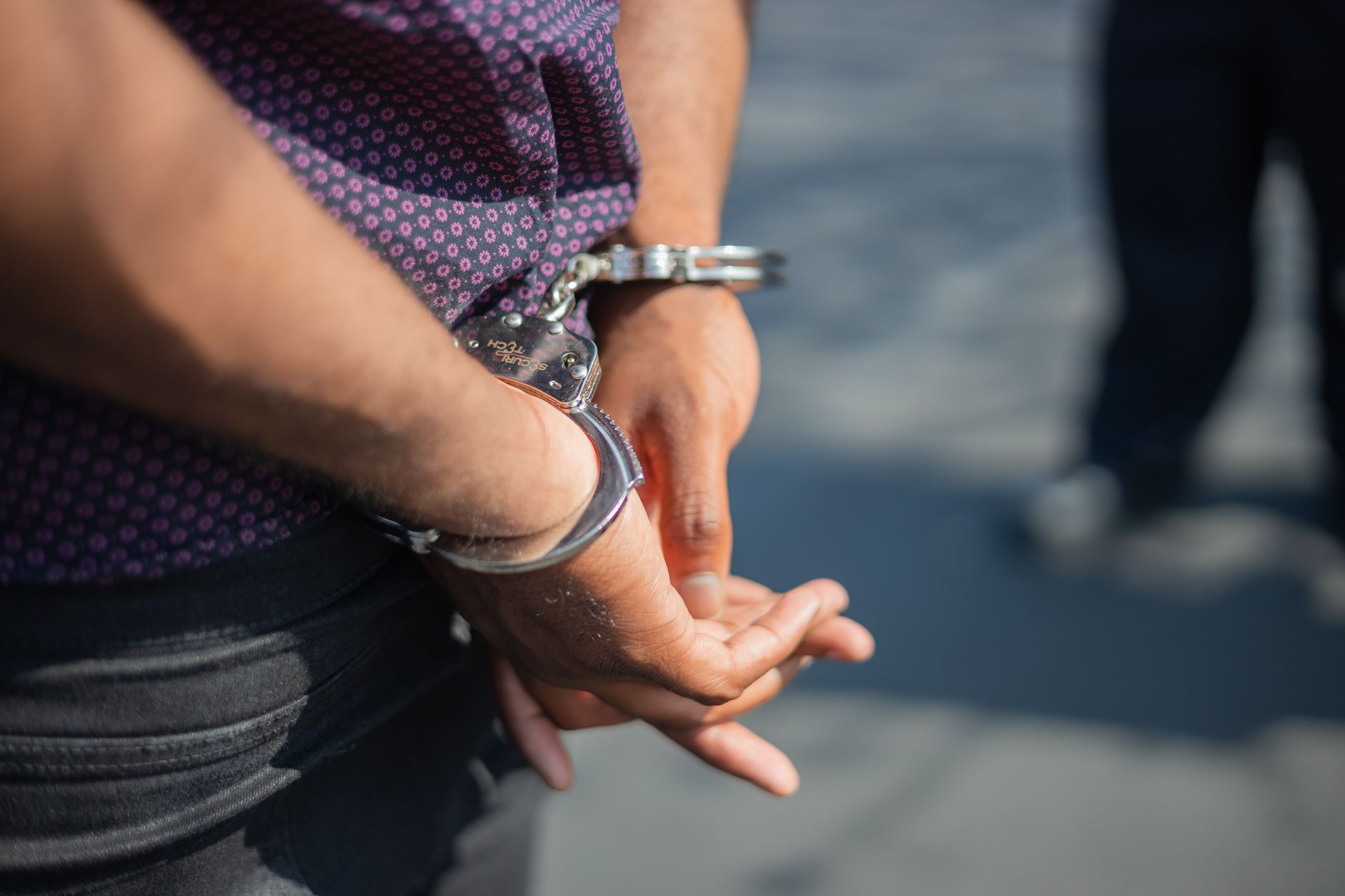
The classic scenario is well known: a conversation that drifts into intimacy, a recording made without consent, then the threat of sending it "to your colonel", "to your chief superintendent", "to your unit's Facebook page". What to keep in mind:
- Blackmail is a criminal offence in itself. Article 312-10 of the French Criminal Code punishes extortion through the threat of defamatory disclosure. You are the victim, not the one at fault.
- Never pay. A payment reads as confirmation that you can pay and that you're afraid; the demands start again.
- Document everything immediately: timestamped screenshots, username, account identifiers, the full conversation history, the bank details or wallet address requested.
- Cut the channel, not the evidence. Block and report, but don't delete the conversation.
- File a complaint. You can file at any police station or gendarmerie brigade — including, if that feels safer, outside the area where you are posted. The THESEE platform allows online reporting of certain types of online fraud.
Our in-depth article on homophobic set-ups and blackmail arising from a video chat walks through each step, and the one on reporting, blocking and preserving evidence sets out how to preserve proof.
One point specific to these jobs deserves to be said out loud: you have the right to tell your institution before it hears it from the blackmailer. In most cases, informing an ethics officer, the Thémis unit at the Ministry of the Armed Forces, or a prevention officer completely defuses the threat. LGBT+ staff associations in the public service — such as Mousse or the internal networks within ministries — provide support for exactly this kind of step, and the sex-tape blackmail case tried in 2025 against an elected official from Saint-Étienne publicly made one thing clear: what the courts punish is the blackmail, not the private life of the person targeted.

Deployments, secondments, overseas operations
A deployment adds a layer of risk that has nothing to do with the chain of command: the country you land in. According to the annual report by ILGA World, more than sixty states still criminalise same-sex relations, and several reports from Amnesty International and Human Rights Watch document the use of conversations, photos and apps as evidence during arrests.
Three habits before departure:
- Strip the device down: nothing sensitive in the gallery, messaging apps or applications; accounts you don't need are logged out and removed from the device, not merely hidden.
- Set up two-factor authentication without SMS: an authenticator app works without a local network, and a physical FIDO2 security key protects your accounts even if the phone is seized.
- Know the local rules: what you can say, what you must not download, and the fact that phone searches at the border are lawful in many states.
The details of this preparation are in our article on getting your phone ready before the border.
The minimum protocol, in a nutshell
| Situation | What actually holds up in real life |
|---|---|
| Barrack room or duty dormitory | Closed-back headset, mic off, privacy filter, lid shut the moment someone walks in |
| Service equipment and network | No personal use, ever, no exceptions |
| Camera on | No uniform, no insignia, no documents, neutral backdrop |
| Conversation | Vague about your job, city unmentioned, a consistent first name or username, no social accounts shared |
| Threat or blackmail | No payment, timestamped evidence, a criminal complaint, and your institution informed before the blackmailer does it |
| Deployment abroad | Stripped-down device, 2FA without SMS, local legal framework known |
And the question that always comes up: do you have to hide?
No — and two things that often get confused need separating. Discretion is a tactical tool, not an identity. Many gay and bisexual men serve today while being completely out in their unit, with recognised partners, active staff associations and institutions that take part in Pride marches. This isn't just window dressing: the French armed forces, the national police and the gendarmerie have all signed diversity commitments, and LGBT+ staff networks exist within these administrations.
The choice of when, to whom and in what words belongs to you. What this guide protects is precisely that choice: not being outed by a screenshot, poorly contained sound or a recognisable barrack-room backdrop. If it happens anyway, the next step is covered in our article on limiting the spread and taking back control of the narrative, and helpline and support resources are gathered on our safety page.
One last word, because it matters in jobs where you learn to take it without saying anything: the mental load of a permanent double life is real, and it can be addressed. Charity helplines are free, anonymous, and staffed by trained volunteers. Calling isn't an admission of weakness; it's exactly the same reflex as checking your kit before heading out.